Press: Multimedia
Science Friday – The Organ That Gives Birds Their Voices
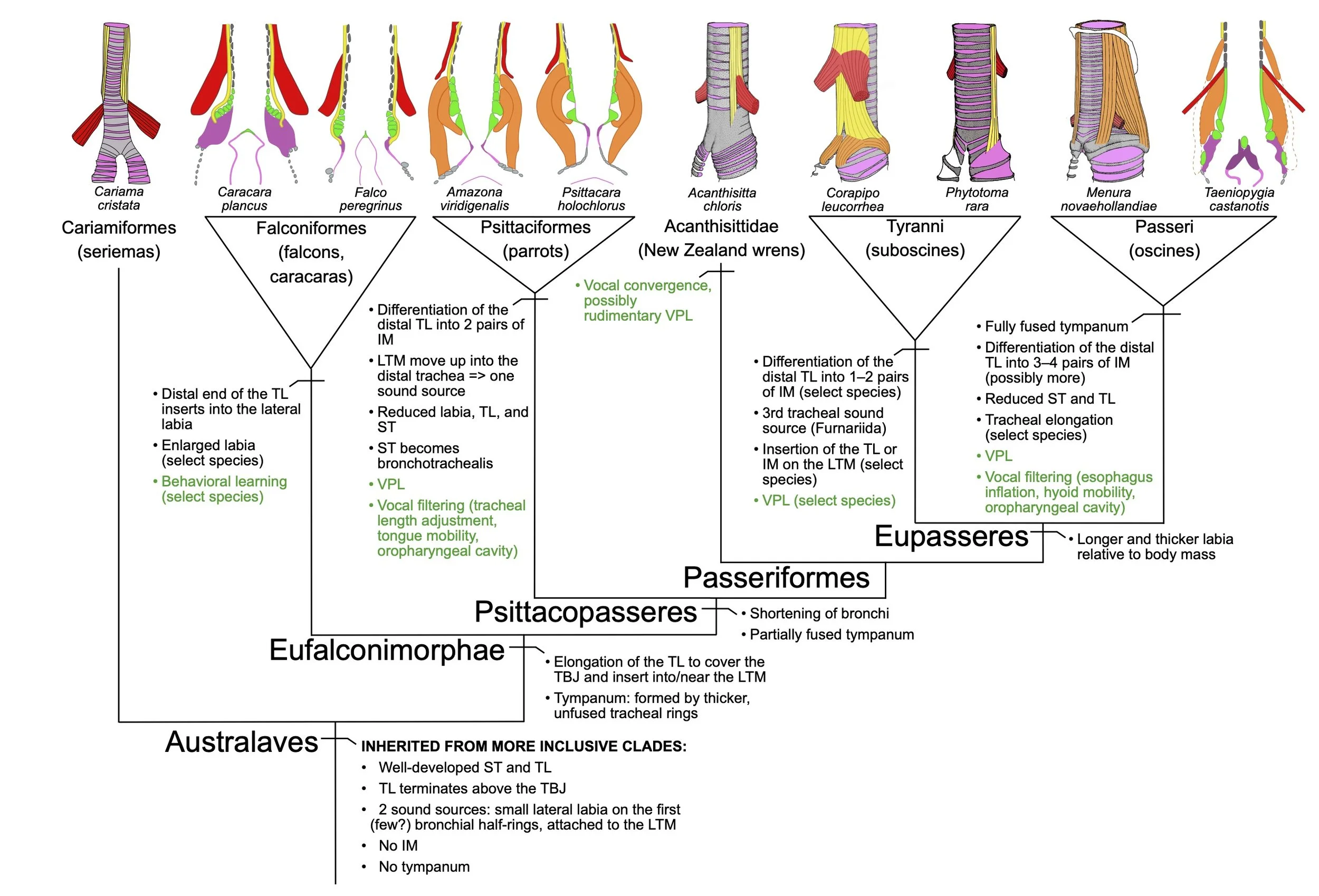
Have you ever wondered how a bird sings? Or made some of their less melodic vocalizations, like squawks, trills, or chirps? It all happens in the syrinx, a vocal organ unique to birds. Reptiles, amphibians, and mammals, including humans, use their larynx to produce sounds. The syrinx varies widely between bird species and there’s still a lot that scientists don’t understand about how it works and its evolutionary history. Better understanding the syrinx of living birds can help scientists get closer to figuring out what dinosaurs sounded like. (No, the dinosaur sounds in “Jurassic Park” are not scientifically accurate.)
Guest host Arielle Duhaime-Ross talks with Dr. Julia Clarke, professor of vertebrate paleontology at the Jackson School of Geosciences at the University of Texas, Austin, about her recent research studying the syrinxes of ostriches and hummingbirds.
Science Friday – How Big Dino Domes Might’ve Saved Today’s Bird Brains
Did larger brains help modern-day birds avoid mass extinction? Hear from evolutionary biology experts Julia Clarke and Chris Torres and ask them your questions.
What Was Poppin’ In Prehistoric America? with Dr. Julia Clarke
On this episode of Getting Curious, we’re digging deep with Dr. Julia Clarke, Wilson Professor of Paleontology at The University of Texas at Austin and a Fellow of the Royal Society of Biology. She and Jonathan get to the bottom of how Texas looked 250 million years ago, which dinosaurs roamed prehistoric America, and what Pangaea’s got to do with the age of dinosaurs.
- Getting Curious with Jonathan Van Ness
Tyrannosaurus FX
When you imagine the sound of a dinosaur, you probably think of a scene from the Jurassic Park movies. How do sound designers make these extinct creatures sound so believably alive? And what does modern paleontology tell us about what dinosaurs REALLY sounded like? Featuring Jurassic World sound designer Al Nelson, and paleontologist Julia Clarke.
- Twenty Thousand Hertz
Great Transitions: The Origin of Birds
In the second film of the Great Transitions trilogy, paleontologist Julia Clarke takes us on a journey to uncover the evidence that birds descended from dinosaurs.
- HHMI Biointeractive
Living Dinosaurs
Julia Clarke talks about her research on the origin of birds.
- Denver Museum of Nature & Science
Microraptor Suggests Feathers Evolved to Attract Mates
Julia Clarke discusses how a tail shape with feathers may have originated as a function of communication rather than aerodynamics, which came later in the evolution of flight.
- The University of Texas at Austin
5-Foot Penguin Fossil Discovered
Scientists have unearthed fossilized remains of a 5-foot-tall penguin in present-day Peru. The 36-million-year-old fossil sheds light on bird evolution, according to National Geographic grantee Julia Clarke.
- The University of Texas at Austin